
 Consider a familiar situation: a suspect has changed course, fresh intelligence arrives from dispatch, and several agencies are contributing units across a wide jurisdiction. The information reaching officers in the field is fragmented, arriving through separate systems, partial radio transmissions, and secondhand accounts. Nobody possesses the complete picture at any given moment. Coordination falters, decisions rest on incomplete detail, and the margin of safety for officers on scene narrows considerably.
This circumstance is neither unusual nor theoretical. Agencies across the country routinely contend with it, and its consequences accumulate in both visible and subtle ways, from delayed arrests to unnecessary exposure during approach. The underlying issue is seldom a shortage of data; rather, it is that the data fails to reach the officer who needs it, when needed, in a form that is immediately useful.
Competent mobile computing addresses this deficit directly. When patrol officers and deputies carry tools that provide current information, accept reports in the field, and continue functioning in areas with poor connectivity, the operational distance between dispatch and the scene contracts in meaningful ways.
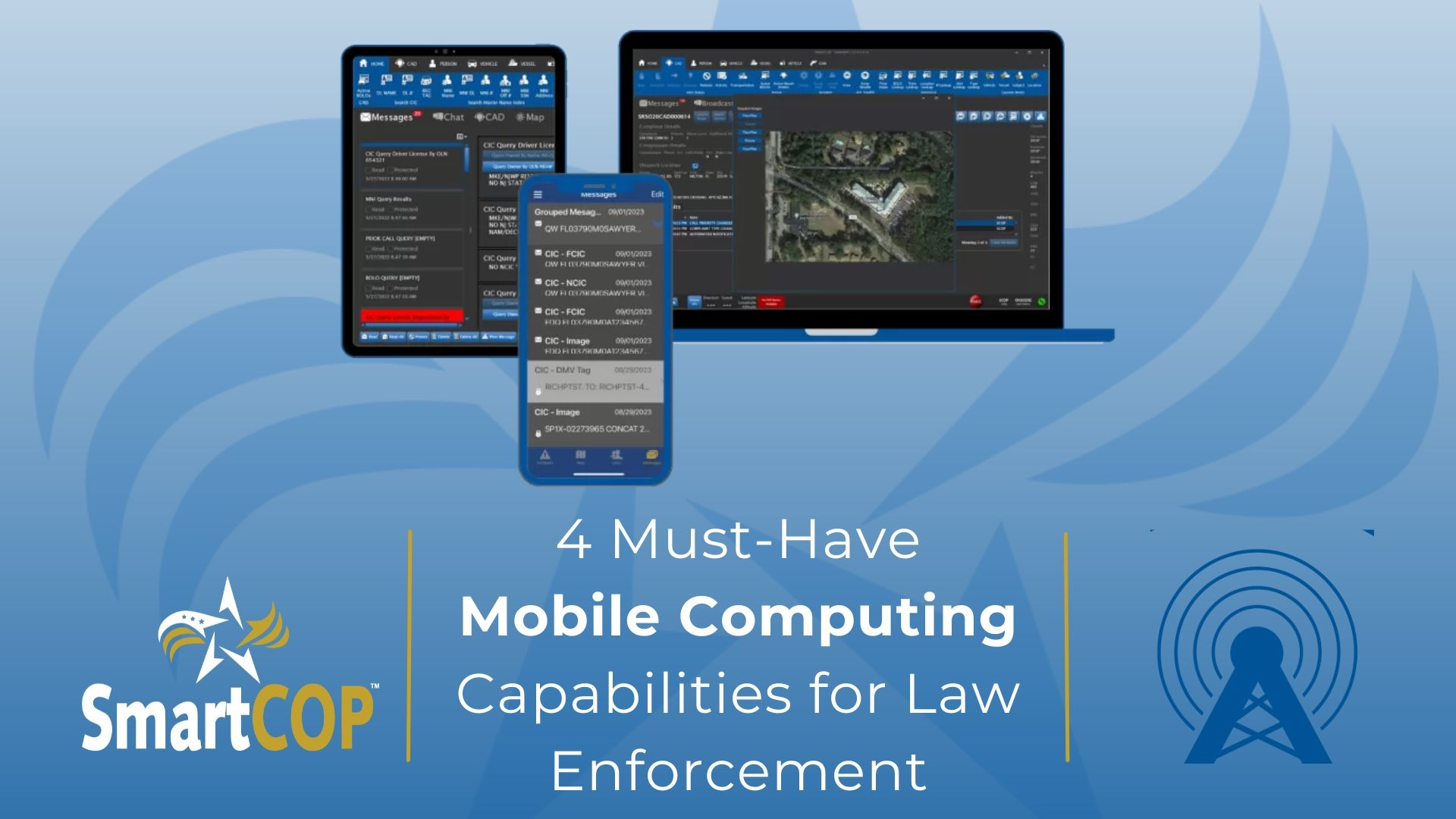
At SmartCOP, mobile computing is the backbone of the SmartMOBILE platform. It combines a mobile computing terminal (MCT), field-based reporting, and message switch access in a single package that officers can learn quickly and depend on throughout a shift. What follows are four capabilities that any agency should regard as foundational when evaluating its mobile technology.
1. Live CAD Access Across Devices Officers Already Carry
The capacity to view active call information, unit positions, and incident progression in real time is arguably the single most consequential feature in any mobile computing deployment. When officers receive CAD data on their MDTs, tablets, or phones through SmartMOBILE’s SmartMCT component, they can adjust their approach while still travelling. In addition to requesting additional units without returning to the vehicle and remain aware of developments that may alter the nature of the call.
For supervisory personnel, the same live feed supports better allocation of resources and a clearer understanding of where units are committed. Silent self-dispatch allows officers to assign themselves to calls without congesting voice channels, which preserves radio availability for urgent traffic.
The practical result is fewer repetitions over the air, quicker positioning of personnel, and a shared operational picture that extends from the communications centre to the patrol car.
SmartMOBILE maintains this functionality even when cellular or network service is interrupted. Calls, status updates, and notes are stored locally and transmitted once the connection resumes. For deputies working rural counties or officers patrolling areas with inconsistent coverage, this is not a supplementary convenience; it is a necessity.
2. Mapping, Routing, and Geofencing That Contribute to Tactical Preparation
Arriving at a location without adequate knowledge of the physical surroundings introduces risk that is, in many cases, avoidable. SmartMOBILE provides integrated GIS mapping and turn-by-turn routing so that officers can identify the most practical access points, observe the positions of nearby units, and orient themselves to the geography before they exit the vehicle.
Geofencing and proximity notifications add a further layer of awareness. Agencies can designate zones around schools, known risk addresses, or active scenes, and officers who enter those areas receive automatic alerts. Arrival detection updates an officer’s status without requiring manual input, which reduces administrative interruption and informs dispatch simultaneously.
Mapping data and recent premise history remain accessible during connectivity lapses, so officers working in coverage gaps retain the spatial context they need. The technology does not merely offer a map; it provides situational orientation grounded in agency-defined intelligence.
3. Field-Based Reporting That Eliminates Redundant Administrative Labour
Few aspects of police work generate as much frustration among line-level officers as the requirement to return to a station to retype information that was already collected at the scene. The time consumed by this duplication is considerable, and the likelihood of transcription errors increases with each additional handling of the same data.
SmartMOBILE’s reporting tools are connected directly to SmartRMS, so that incident details, observations, photographs, and signatures entered in the field populate the records system immediately. NIBRS and FIBRS validations operate within the reporting workflow, prompting officers to capture the correct data elements the first time rather than generating correction requests after the fact.
Message switch access from the field allows state and federal queries, with responses retained alongside the relevant case record. The cumulative effect is a reduction in desk time, fewer rejected reports, and faster availability of case information to investigators and records staff.
Reports can be composed and validated offline. When service returns, the completed work transmits without further intervention from the officer. The practical benefit is uninterrupted productivity regardless of where the shift takes them.
4. Immediate Retrieval of History, Hazards, and Situational Context
Every call carries some degree of uncertainty, but officers who arrive without knowledge of prior incidents at an address, existing cautions on individuals, or relevant case history face a wider margin of the unknown than is acceptable. SmartMOBILE draws on SmartDATA and SmartRMS to present prior calls, premise notes, hazard flags, and associated persons or vehicles to the officer before or upon arrival.
This contextual information supports more deliberate decision-making at the point of contact. Supervisory staff benefit from the same shared data when directing resources or advising personnel in the field. Alerts and caution notices appear within the mobile interface where they are immediately visible, rather than residing in a desktop application that is inaccessible from the scene.
Cached history and hazard records persist during outages, so this layer of awareness does not disappear when coverage does.
Why Agencies Select SmartCOP for Mobile Computing
SmartCOP was developed in close collaboration with patrol officers, corrections staff, and conservation officers whose requirements are grounded in daily operational reality. SmartCAD, SmartMOBILE, SmartRMS, SmartJAIL, and SmartDATA function as a single, connected platform, so that information travels with the incident from the initial call through to the final report without manual transfer between systems.
Full offline capability with automatic synchronisation keeps officers productive along rural patrol routes, within concrete-walled facilities, and during weather events that degrade network infrastructure. For Florida agencies, SmartCOP provides FLHSMV-approved workflows and FIBRS compliance. Agencies beyond Florida benefit from the same field-tested dependability.
Hosting arrangements remain at the discretion of the agency. On-premise, cloud, or a combination of both are all supported configurations.
What This Means During a Shift
Officers and deputies who spend less time managing their technology and more time attending to the work in front of them perform that work with greater attention and lower fatigue. The four capabilities described here, live CAD access, tactical mapping, field-based reporting, and contextual history, are not aspirational features. They are present, tested, and available in SmartMOBILE today, and they continue to function when connectivity does not.
If your agency is evaluating mobile computing platforms and would like to see SmartMOBILE in a practical demonstration, contact our team.